
PRP · Hair Restoration
PRP for hair: follicular stimulation and the science of hair loss
Hair loss affects the majority of men and a significant share of women by their fifties. PRP intervenes in one of the core biological mechanisms (follicular miniaturisation) by delivering concentrated growth factors directly to the scalp.
Hair follicle biology: the growth cycle
Each hair follicle operates through a repeating cycle of three phases. The anagen phase is active growth, the follicle is metabolically active and producing a hair shaft. This phase lasts 2 to 7 years in scalp hair and determines hair length. The catagen phase is a brief transitional regression, lasting 2 to 3 weeks. The telogen phase is the resting period, approximately 3 months, after which the hair sheds and the cycle restarts.
In a healthy scalp, roughly 85 to 90% of follicles are in anagen at any given time. In progressive hair loss, this balance shifts: more follicles enter telogen and remain there, anagen phases shorten, and follicles miniaturise, producing progressively thinner, shorter hairs until they effectively cease activity. PRP works by intervening before miniaturisation becomes permanent.
The mechanisms of hair loss
Androgenetic alopecia, in simple terms pattern hair loss, is by far the most common form, affecting approximately 50% of men by age 50 and 25% of women. It is driven by dihydrotestosterone (DHT), produced from testosterone by the enzyme 5-alpha reductase. DHT binds to androgen receptors in genetically susceptible follicles and triggers a progressive miniaturisation process: each successive growth cycle produces a shorter, finer hair, until the follicle produces only fine vellus hair, barely visible, and eventually becomes dormant.
The transition from active follicle to dormancy is gradual, not sudden. This creates a therapeutic window, the period during which the follicle is miniaturising but not yet permanently inactive, during which interventions like PRP can slow or partially reverse the process. Identifying and acting within this window is the key determinant of treatment success.
The three targets: DHT-driven miniaturisation causes reduced follicular blood supply (dermal papilla vessel constriction), a shortened anagen phase, and progressive loss of dermal papilla cell population, the cellular engine driving follicle activity. PRP addresses all three: VEGF restores follicular microcirculation; PDGF and FGF extend anagen and stimulate dermal papilla cell proliferation; IGF-1 signals against the apoptosis that leads to papilla cell loss.
How PRP acts on hair follicles
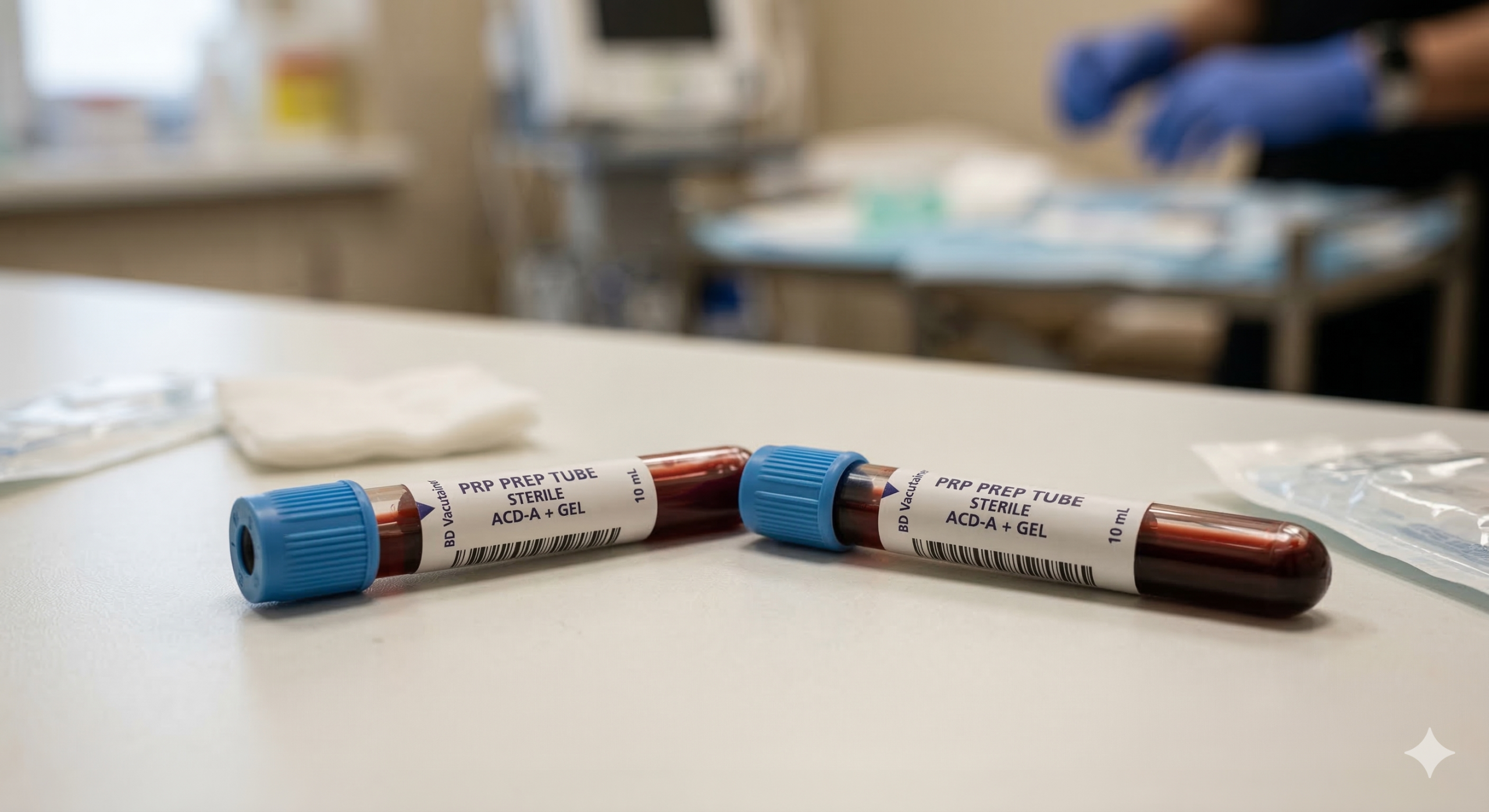
PRP is injected directly into the scalp at the level of the hair follicle, the subdermal layer where the dermal papilla resides. Unlike skin PRP, which distributes through the dermis, scalp PRP must reach a specific anatomical depth to place growth factors adjacent to the follicular control structure.
| PDGF, Platelet-Derived Growth Factor Stimulates fibroblast proliferation and collagen synthesis; the primary driver of dermal tissue remodelling | TGF-ß, Transforming Growth Factor Regulates collagen deposition and MMP inhibition; supports structural tissue repair without excess scarring |
| VEGF, Vascular Endothelial Growth Factor Promotes new capillary formation, improving local oxygenation and reducing the vascular component of dark circles | EGF, Epidermal Growth Factor Accelerates keratinocyte turnover; supports surface skin renewal and repair, improving texture and crepiness |
| IGF, Insulin-Like Growth Factor Anti-apoptotic signalling in dermal cells, promotes cell survival and supports dermal density | FGF, Fibroblast Growth Factor Stimulates collagen and elastin synthesis; directly supports long-term dermal thickness and resilience |
The net effect is a shift back toward anagen: more follicles actively growing, for longer periods, producing thicker hair shafts. PRP does not generate new follicles, it rescues follicles that are miniaturising but have not yet permanently lost their capacity for active growth. Early treatment, before advanced loss, consistently produces better outcomes for this reason.
Clinical evidence
PRP for hair loss has an accumulating evidence base. A 2019 systematic review in the Journal of Cutaneous Medicine and Surgery (Gupta & Versteeg) analysed 19 controlled studies and found consistent evidence for increased hair density and thickness in androgenetic alopecia patients, with statistically significant improvements in hair count per cm² in the majority of trials.
Outcomes vary with patient selection: those with early-to-moderate loss respond best, while patients with extensive miniaturisation or long-standing diffuse loss show more modest results. The quality of PRP preparation, centrifugation protocol, platelet concentration achieved, activation method, accounts for a significant portion of variability across published studies and is a major reason why outcomes differ between providers.
What PRP cannot do
PRP cannot restore follicles that are permanently inactive, where the follicular structure has been replaced by fibrous tissue. In areas where the scalp is smooth and shiny with no visible follicle openings, the therapeutic window has typically passed. This underscores the clinical importance of starting treatment at the first signs of thinning, rather than waiting until loss is visually advanced.
Treatment protocol and timeline
An initial course of 3 sessions spaced 4 to 6 weeks apart is standard, consistent with the protocols used in the majority of clinical studies. This allows each growth factor pulse to build on the previous one, progressively extending anagen phases and increasing follicular activity with each treatment. After the initial course, maintenance every 3 to 6 months is typically recommended. The underlying DHT-driven miniaturisation process does not stop; regular PRP counterbalances it.
Results follow a predictable sequence. Most patients notice reduced shedding within 4 to 6 weeks, the first sign of treatment response, as follicles begin re-entering and sustaining anagen rather than shedding. New growth becomes visible around weeks 8 to 12. The full result of an initial course is typically apparent 4 to 6 months after the final session, as new hair shafts reach appreciable length. Photographic documentation at baseline and follow-up is the most reliable way to track progress.
Preparation and aftercare
Preparation for scalp PRP follows the same logic as skin PRP, the growth factor concentration in the final preparation directly determines the strength of the follicular stimulus. Avoid alcohol for at least 3 days before treatment (it impairs platelet function), pause blood-thinning supplements for one week, stop NSAIDs 3 days prior, and arrive well-hydrated. Smoking significantly reduces circulating VEGF levels, the very growth factor most responsible for restoring follicular blood supply, making it the single most clinically relevant lifestyle factor to address before treatment.
After treatment: avoid washing the hair for 24 hours, this allows PRP to remain at the injection sites rather than being displaced by water and shampoo. Avoid intense exercise for 24 hours. Do not take ibuprofen or other NSAIDs post-treatment; as with skin PRP, the triggered inflammatory response is the mechanism, and suppressing it reduces effectiveness. Some scalp tenderness and mild swelling for 24 to 48 hours is normal and expected.
PRP hair treatment is not suitable during pregnancy or breastfeeding. Not recommended in patients with platelet disorders, those on anticoagulant therapy, or those with active scalp infection in the treatment area.
Ready to put this into practice?
Consultations at HALO are free and never obligatory. Bring your questions.
Book Now