
Botox · Masseter
Masseter Botox helps with jawline, bruxism and tension headaches
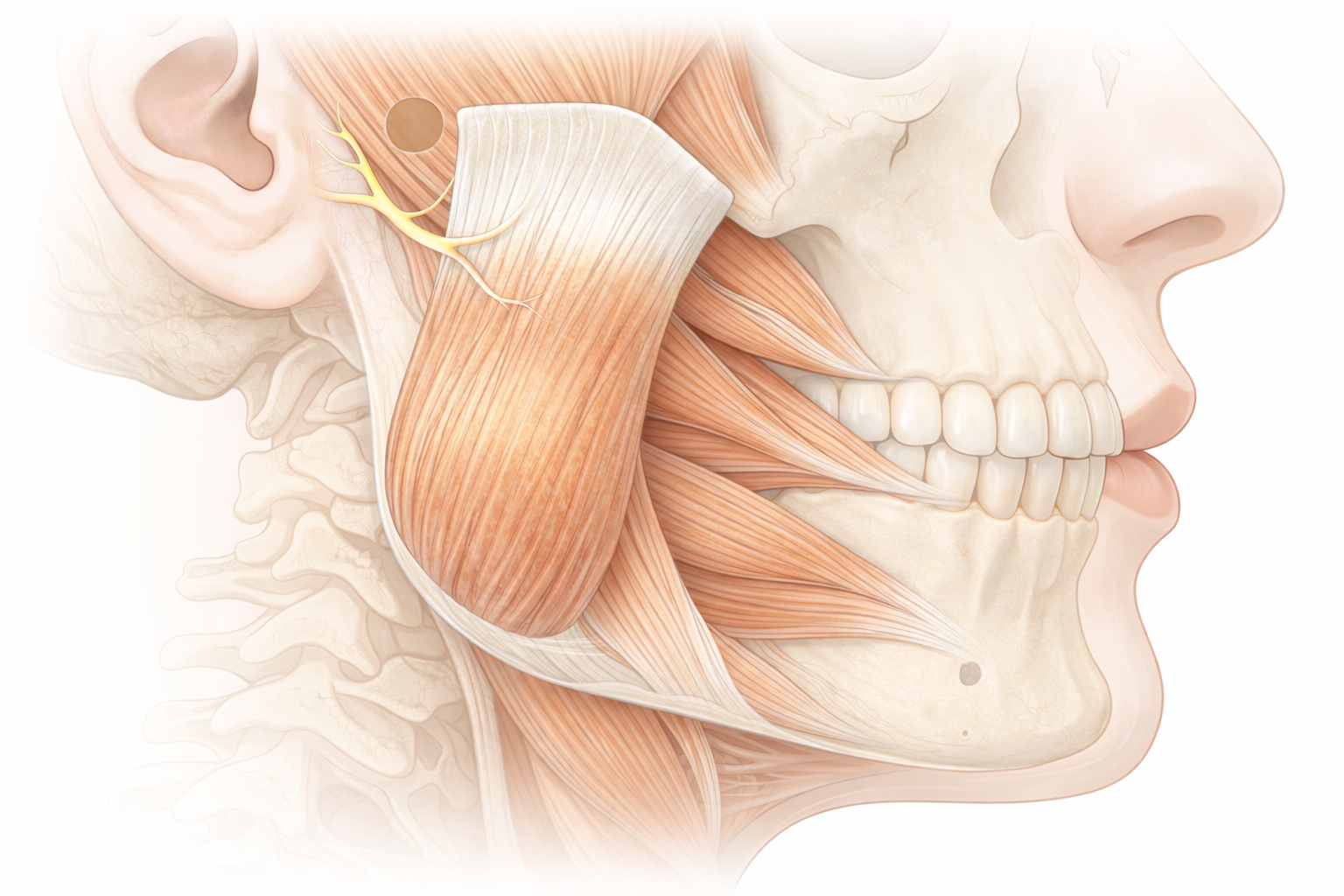
One treatment, three distinct effects. How botulinum toxin in the masseter muscle addresses teeth grinding, reshapes the lower face, and relieves chronic jaw pain and headaches.
The masseter: anatomy and function
The masseter is a paired muscle running from the cheekbone (zygomatic arch) to the lower jaw (mandible). Its primary function is mastication, chewing, and it is one of the most powerful muscles relative to its size in the human body, capable of generating bite forces exceeding 500 Newtons.
In many people, this muscle is chronically overactive, not just during eating, but during sleep (bruxism) or unconscious daytime clenching driven by stress. Over time, chronic overactivity produces three distinct problems: progressive muscle hypertrophy that broadens the lower face, mechanical wear on dentition, and persistent jaw pain, tension headaches, and TMJ symptoms.
Why botulinum toxin works here: The masseter responds to botulinum toxin exactly as any striated muscle does, acetylcholine is blocked at the neuromuscular junction, reducing the muscle’s force-generating capacity. With the muscle working at reduced intensity, it gradually undergoes disuse atrophy, jaw tension decreases, and the overlying facial contour narrows progressively over weeks to months.
Teeth grinding and bruxism
Bruxism affects an estimated 8 to 10% of adults, and up to 30% of those with high-stress lifestyles. It is characterised by involuntary grinding or clenching of the teeth, most commonly during sleep where it cannot be consciously controlled. The consequences accumulate over years: enamel erosion, dentinal sensitivity, cracked cusps, gum recession, and progressive damage to the temporomandibular joint.
Conventional management, occlusal splints and mouthguards, protects the teeth from grinding damage but does not address the underlying muscle overactivity. Botulinum toxin acts at the source: by reducing the force-generating capacity of the masseter, grinding pressure decreases significantly even if muscle movement does not fully cease. The therapeutic effect typically becomes noticeable within 1 to 2 weeks. Patients frequently report waking without jaw soreness for the first time in years.
With repeated treatment, the masseter gradually atrophies, meaning grinding intensity reduces further with each successive session. Many patients find that after two to three consistent treatments, their dose requirement decreases and the interval between treatments can be extended, a positive long-term trajectory rather than an escalating dependency.
On long-term dental consequences
Untreated bruxism can accelerate enamel wear to a degree requiring significant dental restoration over time. Many patients who begin masseter treatment primarily for cosmetic reasons are surprised by the secondary dental benefit, a gain that is frequently underappreciated at the outset but becomes clear in the months that follow.
Jawline slimming: the cosmetic mechanism
The width of the lower face is determined partly by skeletal structure and partly by soft tissue, including masseter muscle volume. In patients with masseter hypertrophy, the muscle bulk adds significant width at the jaw angles, creating a square or rectangular lower facial outline. This is particularly pronounced in individuals with a history of bruxism, where the masseter has hypertrophied in response to chronic overuse.
As botulinum toxin progressively reduces masseter activity over the weeks following injection, the muscle undergoes disuse atrophy, it decreases in volume. The visible result is a gradual narrowing and softening of the lower face, shifting toward a more oval facial contour. This effect develops on a distinctly slower timeline than other Botox applications.
Tension headaches and TMJ pain
Chronic masseter overactivity generates persistent muscle tension that radiates well beyond the jaw. The referred pain patterns of this muscle are well-documented: trigger points can produce headaches at the temples and forehead, earache-like symptoms, and pain along the cheekbone. Many patients presenting with “tension headaches” or unexplained tooth sensitivity have undiagnosed masseter overactivity as the primary driver.
The temporomandibular joint sits directly adjacent to the masseter. Chronic masseter tension loads the TMJ asymmetrically, contributing to clicking, locking, and progressive joint wear. Reducing masseter activity with botulinum toxin directly reduces the mechanical load on the joint, often resolving TMJ symptoms that years of splint therapy had failed to address.
The link between masseter treatment and headache reduction is not incidental. Botulinum toxin has an established evidence base in chronic migraine (the PREEMPT protocol); the mechanism, reduced muscle tension and potentially direct inhibition of nociceptive peptide release, also operates at the masseter level. Many patients treated primarily for cosmetic reasons report a significant reduction in chronic headache frequency as an unintended but welcome secondary benefit.
Timeline, dosing, and long-term trajectory
Masseter treatment requires a higher dose than most facial Botox applications, reflecting the muscle’s size and strength. The appropriate dose is assessed at consultation by palpating the muscle at maximal clench, a process that takes seconds and immediately reveals the degree of hypertrophy. A typical therapeutic range is 20 to 40 units per side.
The first treatment produces the smallest cosmetic effect, as the muscle has not yet had time to atrophy. The second and third treatments, typically spaced 4 to 6 months apart, produce progressively more pronounced slimming, as each cycle of reduced activity allows further volume reduction. After two to three consistent sessions, many patients find their dose requirement falls and treatment intervals extend naturally. The long-term trajectory is toward a stable, reduced muscle volume requiring only infrequent maintenance.
Managing natural asymmetry
Most people have some degree of natural masseter asymmetry, one side slightly larger than the other, often related to the dominant chewing side. This is assessed at consultation and dosing is adjusted accordingly. Correction of asymmetry is typically achievable within one to two treatment cycles.
Aftercare
Softer foods for the first 24 to 48 hours are recommended, not because the injection site is fragile, but to avoid activating the masseter intensely while the product is distributing. Avoid facial massage, gua sha, and any tools that apply pressure to the jaw area for at least two weeks. This prevents unintended migration of the product away from the target muscle.
Standard Botox precautions apply: avoid strenuous exercise for 24 hours, no lying flat for 4 hours post-injection, and no extreme heat exposure (sauna, steam) for 24 hours. Mild tenderness at injection sites is normal and resolves within 1 to 2 days. Contraindications: not recommended during pregnancy or breastfeeding, not suitable for neuromuscular junction disorders, caution required with blood-thinning medications.
Ready to put this into practice?
Consultations at HALO are free and never obligatory. Bring your questions.
Book Now