
PRP · Skin Rejuvenation
PRP for skin, eyes, full face, and the growth factor cascade
Your blood contains a concentrated repair system. PRP isolates it and delivers it precisely where the skin needs regeneration: the delicate under-eye zone and the full face.
The biology of PRP: a concentrated repair signal
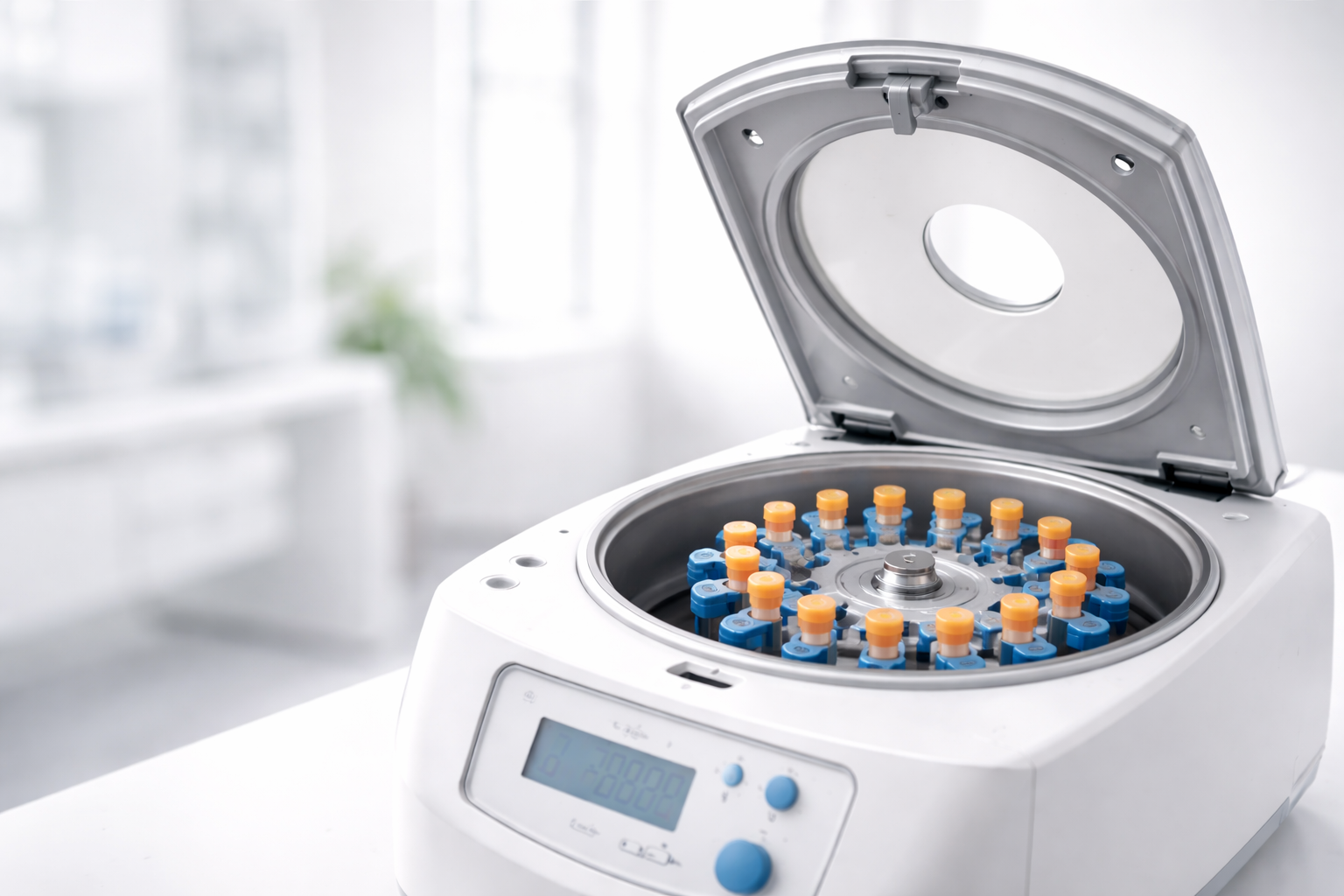
Platelet-Rich Plasma is prepared by drawing a small volume of the patient’s own blood and centrifuging it to concentrate the platelet fraction at 5 to 10 times its physiological level. Platelets are not simply clotting agents, they are storage vessels for a dense collection of bioactive growth factors that, upon activation at the injection site, initiate a coordinated tissue repair cascade.
Because PRP is autologous (meaning derived entirely from the patient’s own body) the risk of immune reaction or foreign body response is essentially zero. This biocompatibility makes it uniquely well-suited to sensitive areas like the under-eye zone, where many other injectables carry disproportionate complication risks.
| PDGF, Platelet-Derived Growth Factor Stimulates fibroblast proliferation and collagen synthesis; the primary driver of dermal tissue remodelling | TGF-ß, Transforming Growth Factor Regulates collagen deposition and MMP inhibition; supports structural tissue repair without excess scarring |
| VEGF, Vascular Endothelial Growth Factor Promotes new capillary formation, improving local oxygenation and reducing the vascular component of dark circles | EGF, Epidermal Growth Factor Accelerates keratinocyte turnover; supports surface skin renewal and repair, improving texture and crepiness |
| IGF, Insulin-Like Growth Factor Anti-apoptotic signalling in dermal cells, promotes cell survival and supports dermal density | FGF, Fibroblast Growth Factor Stimulates collagen and elastin synthesis; directly supports long-term dermal thickness and resilience |
PRP Eyes: the under-eye area
The skin of the lower eyelid is among the thinnest on the body, typically 0.5mm, compared to 2mm elsewhere on the face. This anatomical thinness means the structural changes of skin ageing manifest here earliest and most visibly: hollowing as orbital fat redistributes, dark circles where the underlying vasculature shows through diminished dermis, fine lines from dehydration and repetitive movement, and a crepey surface texture from progressive collagen loss.
PRP is particularly well-suited to under-eye treatment for two reasons. First, its autologous nature permits very superficial injection without the complication risks that accompany hyaluronic acid fillers in this location, where vascular events, the Tyndall effect, and filler migration are disproportionately reported. Second, the growth factor payload it delivers addresses the specific mechanisms driving under-eye deterioration: VEGF improves local microcirculation, reducing the vascular contribution to dark discolouration; PDGF and FGF stimulate new collagen deposition, gradually thickening the dermis; EGF supports surface renewal, improving skin texture.
Results develop gradually over 4 to 8 weeks as the regenerative cascade unfolds beneath the skin. Improvement is cumulative: a course of 2 to 3 sessions spaced 4 to 6 weeks apart produces substantially better structural outcomes than a single treatment, as each session builds on the foundation laid by the last. Patients typically describe the under-eye area as looking less hollowed, less discoloured, and more structurally supported.
PRP Full Face: comprehensive skin regeneration
Full face PRP applies the growth factor cascade broadly across the facial skin, addressing overall skin quality, tone, texture, and the cumulative structural changes of ageing simultaneously. It is particularly effective for patients presenting with uneven pigmentation, post-inflammatory hyperpigmentation from acne, general skin dullness, and early-to-moderate loss of facial skin density.
The approach differs from the targeted under-eye application. PRP is distributed across multiple zones like cheeks, forehead, temples, perioral area, jawline, using a combination of micro-injection techniques to ensure even distribution through the dermis. The total growth factor load delivered is substantially higher, and the regenerative response correspondingly broader in scope.
For hyperpigmentation and post-acne scarring specifically, full face PRP shows particularly strong results. The combination of PDGF-driven fibroblast activity and VEGF-mediated microvascular remodelling addresses both the structural component of scarring (degraded dermal matrix) and the pigmentary and vascular residues that produce lasting discolouration. A course of 3 sessions is typically recommended for these concerns, with results continuing to mature for 3 to 6 months after the final treatment.
Combining PRP with microneedling
Applying PRP immediately following microneedling significantly enhances outcomes for full face treatments. The micro-channels created by needling allow deeper and more evenly distributed penetration of the growth factor concentrate, while simultaneously triggering an independent collagen induction response. The two mechanisms are additive, clinical results from the combination consistently exceed what either approach achieves alone.
PRP versus polynucleotides for skin
Both PRP and polynucleotides stimulate dermal regeneration and improve skin quality, but through different biological mechanisms and with different clinical strengths. Choosing between them, or combining them, depends on the primary concern being addressed.
| PRP IS PARTICULARLY EFFECTIVE FOR Post-acne scarring, hyperpigmentation, under-eye hollowing and dark circles, overall skin dullness, and patients who prefer fully autologous treatment with no foreign material introduced. | POLYNUCLEOTIDES ARE PARTICULARLY EFFECTIVE FOR Structural skin quality and density improvement, deep hydration, fine line reduction, and cases where longevity per session is the priority, each treatment cycle typically produces longer-lasting results. |
In practice, many patients benefit most from a protocol combining both. PRP addresses acute regenerative concerns (like scarring, pigmentation, vascular dark circles) while polynucleotides build the structural baseline over time. The two treatments are not redundant; they operate on complementary pathways and are frequently used together at HALO for patients seeking comprehensive skin quality improvement.
Why preparation directly affects results
PRP is unique among aesthetic treatments in that the quality of the end product is directly determined by the patient’s biological state at the time of treatment. The platelet concentration achieved, and the growth factor richness of the concentrate, are measurably affected by lifestyle in the days before treatment.
Pre-treatment protocol
Avoid alcohol for at least 3 days, as alcohol directly impairs platelet function and reduces growth factor activity. Pause blood-thinning supplements (omega-3, vitamin E, aspirin) for at least one week. Stop NSAIDs (ibuprofen, diclofenac) at least 3 days prior. Arrive well-hydrated. Sleep quality in the preceding days measurably improves platelet performance. Smoking significantly impairs growth factor function. This is clinically relevant, not a routine health disclaimer.
Aftercare
The most counterintuitive aftercare rule: do not use ice, arnica, or anti-inflammatory medications (ibuprofen, diclofenac) after PRP treatment. The mild inflammatory response that PRP triggers is not a side effect to be suppressed, it is the mechanism. Growth factors work by activating the body’s own inflammatory repair cascade. Anti-inflammatory agents directly blunt this response and reduce treatment effectiveness.
For under-eye treatment: avoid rubbing the eye area, wearing contact lenses, and applying heavy eye creams for 48 hours. Mild swelling and redness around the eyes is normal and typically resolves within 24 hours. For full face treatment: avoid intense physical exertion, saunas, and steam rooms for 48 hours, and keep skincare minimal: no retinoids, acids, or alcohol-based products for 72 hours.
Ready to put this into practice?
Consultations at HALO are free and never obligatory. Bring your questions.
Book Now