
Skin Science · UV Radiation
UV radiation and photo-aging: the science of sun damage
UV radiation accounts for an estimated 80 to 90% of visible facial aging. Understanding the mechanism explains why daily SPF is not optional and why it underpins the aftercare for every treatment at HALO.
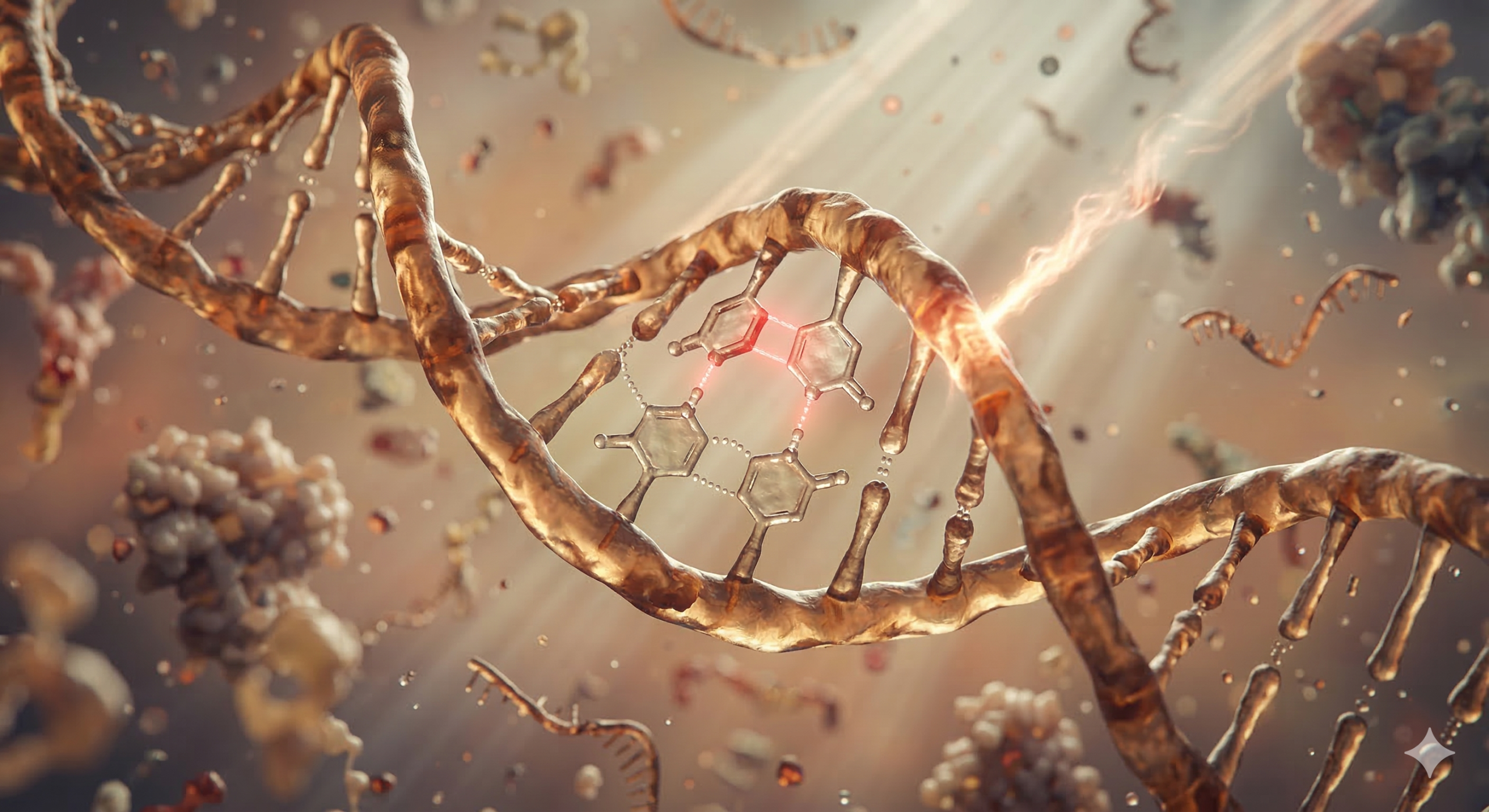
UVB: DNA damage and sunburn
UVB rays (280 to 315 nm) are primarily absorbed by the epidermis. They cause direct DNA damage by inducing the formation of cyclobutane pyrimidine dimers (CPDs), which are abnormal bonds between adjacent thymine bases in the DNA strand. If not repaired efficiently by nucleotide excision repair mechanisms, these dimers result in mutation accumulation that drives both carcinogenesis and chronic tissue dysfunction.
UVB is responsible for sunburn, and its intensity varies significantly with season, latitude, and time of day. However, the absence of sunburn does not indicate the absence of UV-induced damage, because UVA operates on a different and more continuous basis.
UVA: the deeper and more constant threat
UVA rays (315 to 400 nm) account for approximately 95% of UV radiation reaching the Earth’s surface. Unlike UVB, UVA intensity is relatively constant throughout the day, across seasons, and penetrates clouds and glass. UVA penetrates significantly deeper than UVB, reaching the dermis, where collagen and elastin are located.
UVA causes indirect DNA damage primarily through the generation of reactive oxygen species (ROS). It also directly activates enzymes called matrix metalloproteinases (MMPs) in dermal fibroblasts, the primary mechanism behind UVA-driven photo-aging: progressive enzymatic dismantling of the dermis’s structural scaffold.
WHY THIS MATTERS FOR CLINICAL TREATMENTS
Treatments that stimulate collagen synthesis, polynucleotides, PRP, microneedling, are substantially more effective when ongoing UV-driven collagen degradation is minimized. Daily SPF is not aftercare formality; it is a prerequisite for sustaining the structural improvements treatments create.
The SPF evidence
Broad-spectrum SPF 30+ blocks approximately 97% of UVB radiation. True broad-spectrum products also attenuate UVA, whether they use mineral or chemical filters. In Europe, the UVA PF is required to be at least one-third of the SPF value. SPF is only as effective as its application. The standard SPF test uses 2mg/cm², however most people apply less than half this amount. Applying generously and reapplying every two hours in direct sun is not excessive; it reflects how the product was tested.
SPF does not meaningfully block infrared radiation (IR-A), which also penetrates to the dermis and generates ROS. Topical antioxidants (Vitamin C, E, ferulic acid) extend photoprotection by neutralizing ROS that SPF does not prevent, making them a meaningful complement, not a substitute.
Photoprotective supplements
Polypodium leucotomos (tropical fern extract) is the most studied oral photoprotective agent. It reduces UV-induced erythema, limits CPD formation, and attenuates MMP activation in controlled studies. Typically dosed at 240 to 480mg before UV exposure. It supplements but does not replace topical SPF.
Astaxanthin (a carotenoid from algae) has evidence for reducing UV-induced ROS, protecting skin lipids from oxidative degradation, and supporting collagen integrity under UV stress. Typical effective dose 4 to 8mg daily with a fat-containing meal.
Vitamin C + Vitamin E in combination provide synergistic antioxidant photoprotection. Vitamin C regenerates oxidized Vitamin E, maintaining antioxidant activity under UV stress. The combination has stronger evidence than either alone. Commonly dosed at 500mg Vitamin C + 200 IU Vitamin E daily.
References
- Mullenders LHF . Solar UV damage to cellular DNA: from mechanisms to biological effects. Photochem Photobiol Sci. 2018;17(12):1842-1852. PMID 30065996.
- Battie C, Jitsukawa S, Bernerd F, et al. New insights in photoaging, UVA induced damage and skin types. Exp Dermatol. 2014;23 Suppl 1:7-12. PMID 25234829.
- Krutmann J. Ultraviolet A radiation-induced biological effects in human skin: relevance for photoaging and photodermatosis. J Dermatol Sci. 2000;23 Suppl 1:S22-S26. PMID 10764987.
- Quan T, Qin Z, Xia W, et al. Matrix-degrading metalloproteinases in photoaging. J Investig Dermatol Symp Proc. 2009;14(1):20-24. PMID 19675548.
- Petersen B, Wulf HC. Application of sunscreen--theory and reality. Photodermatol Photoimmunol Photomed. 2014;30(2-3):96-101. PMID 24313722.
- Schroeder P, Pohl C, Calles C, et al. Cellular response to infrared radiation involves retrograde mitochondrial signaling. Free Radic Biol Med. 2007;43(1):128-135. PMID 17561101.
- Murray JC, Burch JA, Streilein RD, et al. A topical antioxidant solution containing vitamins C and E stabilized by ferulic acid provides protection for human skin against damage caused by ultraviolet irradiation. J Am Acad Dermatol. 2008;59(3):418-425. PMID 18603326.
- Middelkamp-Hup MA, Pathak MA, Parrado C, et al. Oral Polypodium leucotomos extract decreases ultraviolet-induced damage of human skin. J Am Acad Dermatol. 2004;51(6):910-918. PMID 15583582.
- Ito N, Seki S, Ueda F. The Protective Role of Astaxanthin for UV-Induced Skin Deterioration in Healthy People-A Randomized, Double-Blind, Placebo-Controlled Trial. Nutrients. 2018;10(7). PMID 29941810.
- Eberlein-König B, Placzek M, Przybilla B. Protective effect against sunburn of combined systemic ascorbic acid (vitamin C) and d-alpha-tocopherol (vitamin E). J Am Acad Dermatol. 1998;38(1):45-48. PMID 9448204.
Ready to put this into practice?
Consultations at HALO are free and never obligatory. Bring your questions.
Book Now