
Skin Science · Daily Practice
The evidence-based skincare routine
Most skincare advice is not evidence-based. This is. A practical guide to the actives with clinical proof behind them: what to use, when, and in what order.
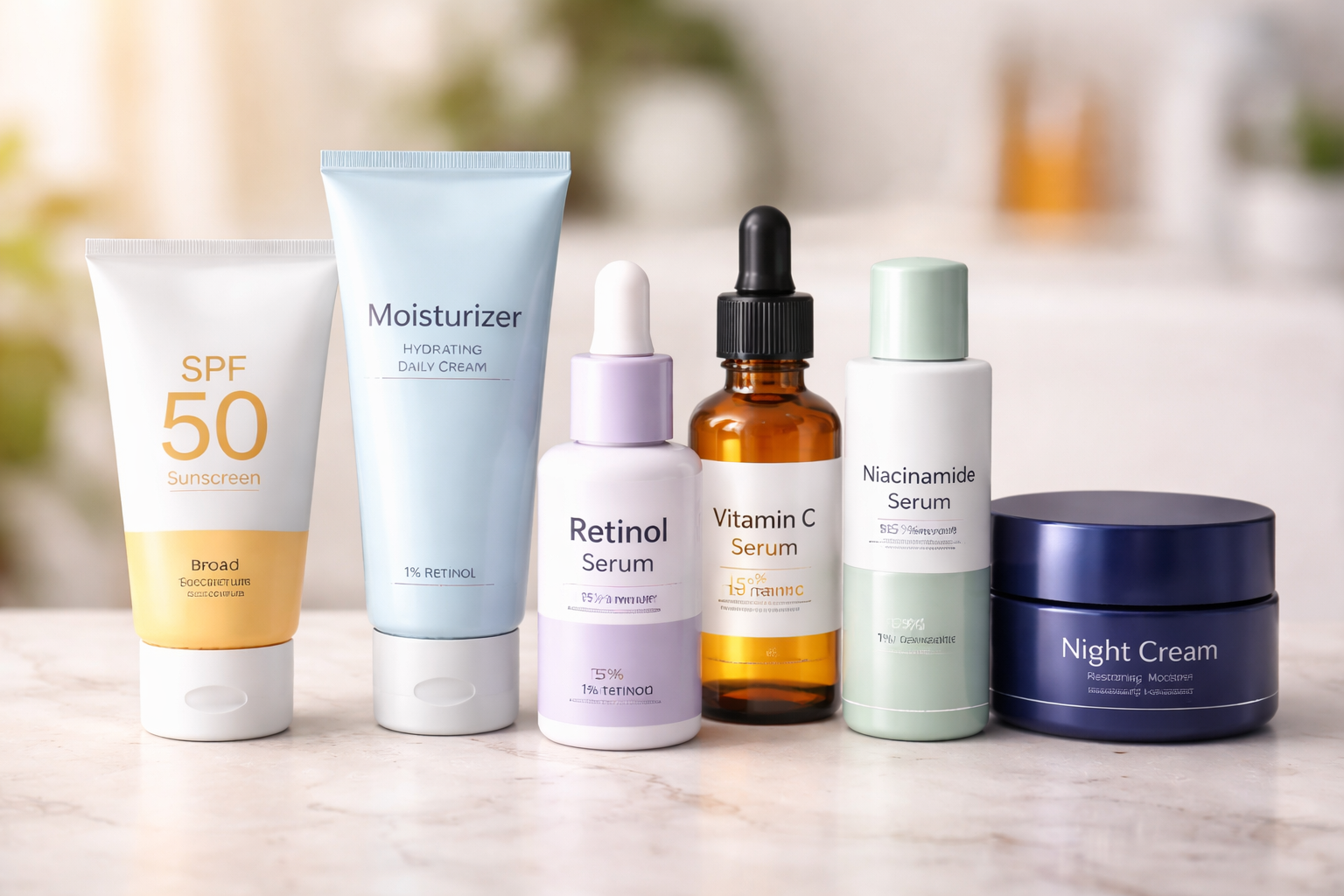
What actually works and what doesn't
The skincare market is enormous and the evidence base behind it is thin. Most products rely on in-vitro data, short-term hydration measurements, or consumer perception studies to make their claims. A small number of ingredients have genuine, replicated clinical evidence for meaningful effects on skin structure, pigmentation, and ageing. This guide covers those ingredients only.
The actives with the strongest evidence base are: SPF (sun protection, the single most important intervention for long-term skin health), retinoids (vitamin A derivatives, the only topical compound with strong evidence for stimulating new collagen), Vitamin C (antioxidant protection and collagen co-factor), niacinamide (barrier function and pigmentation), peptides (signalling molecules for collagen synthesis), and a well-formulated moisturiser. Everything else is optional.
The compounding principle: Unlike treatments, topical skincare works by daily cumulative effect. Applying SPF every day for ten years has a measurably different outcome than applying it occasionally. The same applies to retinol and Vitamin C. Consistency over years, not intensity over weeks, is what produces structural change.
Morning routine
The morning routine has one non-negotiable: SPF. Everything else is secondary. The sequence matters because each layer should be applied from lightest to heaviest consistency, and because some actives (particularly Vitamin C) function as antioxidant pre-treatment before UV exposure.
| Step 1, Cleanser (optional) A gentle, non-stripping cleanser if needed. Many people with normal-to-dry skin do not need to cleanse in the morning, rinsing with water is sufficient and avoids disrupting the skin barrier rebuilt overnight. | Step 2, Vitamin C serum Applied to clean, dry skin. L-ascorbic acid at 10 to 20% concentration provides antioxidant protection against UV-induced free radicals and supports collagen synthesis. Apply before SPF for best photoprotective synergy. Allow to absorb 1 to 2 minutes. |
| Step 3, Niacinamide (optional) Can be layered after Vitamin C. Niacinamide 5 to 10% supports the skin barrier, reduces transepidermal water loss, and has evidence for reducing pigmentation. Does not need to be morning-only, can also be used in the evening. The old concern about mixing niacinamide with Vitamin C causing flushing is not supported by modern formulation data. | Step 4, Moisturiser A basic hydrating moisturiser supporting barrier function. If your SPF has a good base formulation, a separate moisturiser is not always necessary, double-check whether your SPF provides adequate hydration. |
| Step 5, SPF (non-negotiable) SPF 50, broad-spectrum UVA+UVB, applied as the final step every morning. Minimum 0.5ml for the face (roughly a teaspoon). Reapply every 2 hours if outdoors. This is the single most evidence-backed anti-ageing intervention available. See the UV & Photo-Ageing article for full detail. |
Evening routine
The evening routine is where the regenerative actives go. The skin’s own repair processes are most active during sleep, and retinol, the cornerstone of evidence-based anti-ageing skincare, is applied exclusively at night, both because it is photosensitive and because the repair environment of sleep amplifies its effects.
| Step 1, Double cleanse An oil-based cleanser first (removes SPF and sebum effectively), followed by a gentle water-based cleanser. Removing SPF completely is important, residue can impair the absorption of actives applied after. | Step 2, Retinol (2 to 3× per week) Applied after cleansing, before moisturiser. Start at 0.25 to 0.5% retinol, every other night for the first 4 to 6 weeks, then increase frequency and concentration as tolerated. Retinol is the most evidence-backed topical active for collagen stimulation, fine line reduction, and cellular turnover. See the dedicated Retinoids article for full mechanism and dosing. |
| Step 2 (non-retinol nights), Peptides or niacinamide On nights when retinol is not used, peptides (particularly copper peptides and Matrixyl/palmitoyl peptides) support collagen synthesis and barrier repair. Niacinamide also works well on these nights. These are gentler actives that complement retinol without competing. | Step 3, Moisturiser / barrier cream A richer moisturiser than the morning version, supporting overnight barrier repair. Ingredients to look for: ceramides, fatty acids, glycerin. On retinol nights, applying moisturiser after retinol (the “sandwich method”) reduces irritation without significantly impairing efficacy. |
| Step 4, Night cream (optional) A dedicated night cream with actives like bakuchiol (gentle retinol alternative), peptides, or growth factors can be beneficial, but is not essential if a good moisturiser is already in place. Avoid heavy occlusive night creams if you use retinol, they can increase irritation by trapping the active against the skin. |
Weekly schedule at a glance
Vitamin C every morning before SPF. Retinol 2 to 3 evenings per week, never every night, especially when starting. On other evenings: peptides or niacinamide. SPF is the only daily non-negotiable.
EVERY DAY 2 to 3× / WEEK OTHER DAYS NOT APPLIED ☀ MORNING ① Cleanser Optional → ② Vitamin C Every morning → ③ Niacinamide Optional → ④ Moisturiser If needed → ⑤ SPF 50 Non-negotiable ☾ EVENING ① Double Cleanse Every evening → ②a Retinol 2 to 3× / week OR ②b Peptides Other evenings → ③ Moisturiser Richer formula WEEKLY RHYTHM, RETINOL NIGHTS MON Retinol TUE Peptides WED Retinol THU Peptides FRI Retinol SAT Peptides SUN Peptides Start: retinol only every other evening for the first 4 to 6 weeks until tolerated well.Why retinol is evening-only
Retinol is photosensitive, UV light degrades it rapidly. More importantly, retinol accelerates cellular turnover, making the skin temporarily more sensitive to UV damage. Applying it at night, followed by SPF the next morning, is the correct protocol. This is not optional.
The actives: evidence summary
| SPF, Broad-spectrum UVA/UVB Evidence level: Highest. The most evidence-backed anti-ageing intervention in dermatology. Prevents photoageing (80 to 90% of visible skin ageing is UV-driven), reduces skin cancer risk. Daily SPF 50 is non-negotiable. See the UV article for full detail on UVA vs UVB and common SPF myths. | Retinol / Retinoids Evidence level: Highest for topicals. The only topical class with robust clinical evidence for stimulating new collagen synthesis, accelerating cell turnover, and improving fine lines and pigmentation over time. See the dedicated Retinoids article, this is covered in full detail there. |
| Vitamin C (L-ascorbic acid) Evidence level: Strong. Dual mechanism: antioxidant (neutralises UV-induced free radicals) and collagen co-factor (required for collagen synthesis, without adequate Vitamin C, fibroblasts cannot produce normal collagen). Effective at 10 to 20% L-ascorbic acid. Unstable, choose stable formulations and store away from heat and light. | Niacinamide (Vitamin B3) Evidence level: Strong. Supports ceramide synthesis (barrier function), reduces transepidermal water loss, inhibits melanin transfer (reduces pigmentation), and has mild anti-inflammatory properties. Well-tolerated at 5 to 10%. One of the most versatile and well-evidenced actives in over-the-counter skincare. |
| Peptides, Signal & copper peptides Evidence level: Moderate-strong. Signal peptides (palmitoyl pentapeptide/Matrixyl, palmitoyl tripeptide) mimic collagen fragments, stimulating fibroblasts to produce more collagen. Copper peptides (GHK-Cu) promote collagen and elastin synthesis and have wound-healing properties. Results are subtler than retinol but accumulate over consistent use without the irritation profile. | Moisturiser, Ceramides & fatty acids Evidence level: Strong for barrier support. A functional skin barrier reduces transepidermal water loss, reduces sensitivity, and allows actives to work more effectively. Ceramides, fatty acids, and glycerin are the key ingredients to look for. The moisturiser is the foundation, without adequate hydration, other actives are less effective. |
Layering, interactions, and common mistakes
Applying multiple actives in the wrong order, or combining incompatible ones, reduces efficacy and can cause irritation. The main rules are simple.
| DO NOT COMBINE ON THE SAME EVENING Retinol and direct acids (AHAs like glycolic or lactic acid, BHAs like salicylic acid) on the same night. Both accelerate cell turnover and combining them significantly increases irritation risk, particularly at the start of retinol use. Use acids on non-retinol nights if needed. | APPLY IN ORDER OF CONSISTENCY Lightest to heaviest: serums before moisturisers, always. Water-based serums before oil-based products. SPF always last in the morning. This sequence ensures each product can penetrate before being occluded by the next layer. |
The most common mistake
Using too many actives too quickly. Introducing retinol, Vitamin C, and exfoliating acids simultaneously overwhelms the skin barrier and makes it impossible to identify what is causing irritation. Start with one new active at a time, wait 4 weeks before adding the next. The final routine will be more effective, and the path to it far less painful.
Ready to put this into practice?
Consultations at HALO are free and never obligatory. Bring your questions.
Book Now